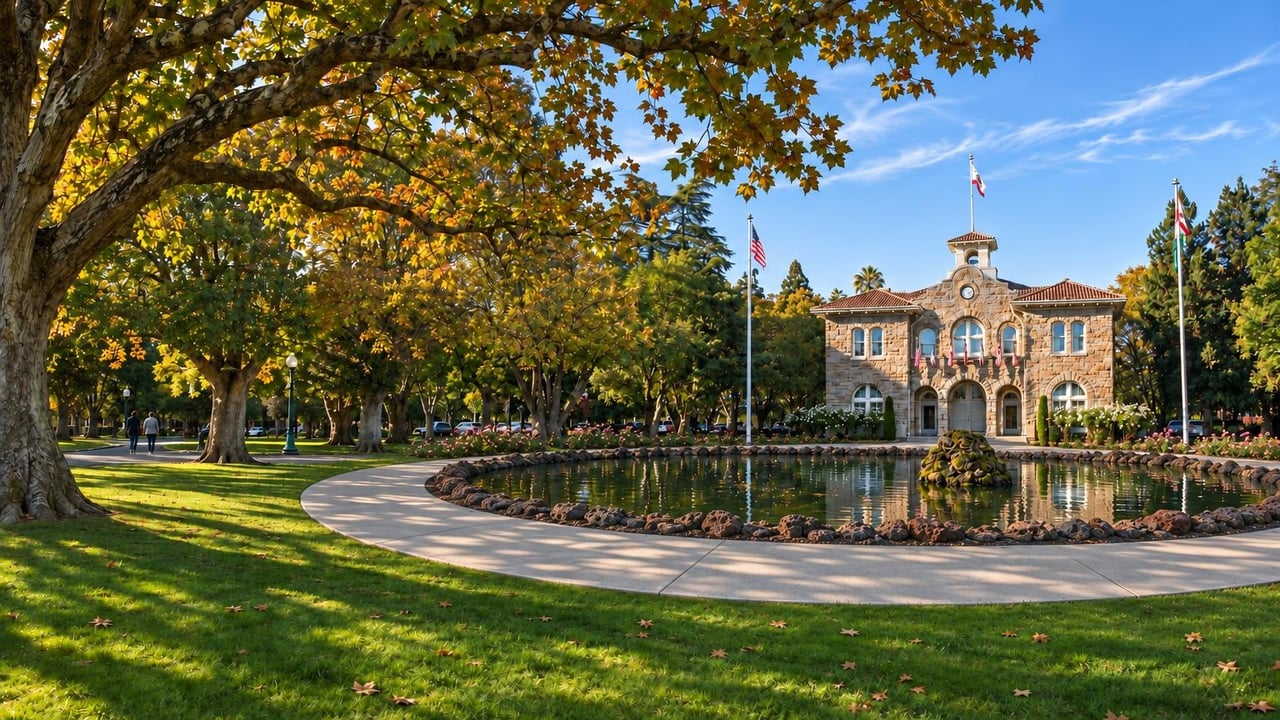
On November 12, new roses went into the horseshoe beds in front of Sonoma City Hall. They replaced plants that had been struggling, and they went in over new soil and drip irrigation. The City did not pay for them out of its capital budget. The work is the Sonoma Plaza Beautification Project, funded by the KHR McNeely Family Foundation through the Valley of the Moon Garden Club. The City Council approved a construction agreement with Vista Landscape on October 7.
Sonoma Plaza has been planted this way for well over a century. A club raises the money, volunteers do the work, and the city looks after what grows. The new roses at City Hall are the latest layer. Over the Thanksgiving weekend, it's a good time to walk the square and see who put what where.
A square that started as bare ground
General Vallejo laid out the Plaza in 1835. Once it stopped being used for military purposes, it was described as weed-strewn and pocked with borrow pits where adobe had been dug. Fixing it was a long project. Vallejo petitioned for improvements in 1851, and a local tax in 1853 paid for the first leveling. Even in an 1871 photograph, the square has only a few trees along its east and south edges, with diagonal footpaths worn across it. By 1888, Monterey cypress lined the perimeter and the axial paths.
The park as we know it starts with the Sonoma Valley Woman's Club, founded in October 1901. Within four months it had planted a memorial tree for General Vallejo. It went on to pay for wider paths, new paths, benches, fertilizer and Bermuda grass. The city's historic survey of Plaza Park, prepared by Architectural Resources Group and dated July 2026, dates the Plaza's period of significance to 1900 through 1940. Those four decades produced most of what you see today.
Start at the horseshoe
City Hall was finished in 1908. A year later, a volunteer cleanup produced the first documented version of the U-shaped driveway and the lawn in front of the building. That U is where this month's roses went in, so the newest planting on the Plaza sits on ground that volunteers shaped in 1909.
Stand at the south entrance and look up. The tall Canary Island date palm in the U-shaped lawn went in in 1910. It was placed in line with the approach up Broadway and the front door of City Hall, and the survey calls it the most prominent specimen tree in the park. The rows of flat-topped Italian cypress beside the driveway frame the same view. On three of the main approaches, London plane trees form allées that lead you into the square.
The survey counted 202 trees of 42 species on the Plaza in 2026. The symmetry around the main paths goes back to 1915, when the city adopted a plan by landscape architect Ralph T. Stevens. In 1916, crews surfaced the paths with crushed rock, added shrubs and moved some trees so the walks would line up.
The southwest quadrant, around the Duck Pond
The Duck Pond was approved in 1932. Edward J. Waterhouse designed it, and the plans called for quarried-rock edging, a stone bridge, a small beach and a rock garden. Today it is a two-lobed concrete basin with an arched stone footbridge, a path around the edge, planted islands and bubbler jets.
There are six mature American elms on the Plaza, and four of them stand together near the pond. The other two are near the northwest and northeast corners. Also in the southwest quadrant is a coast redwood with a plaque naming it the Memorial Redwood, dedicated to General Mariano G. Vallejo in 1948.
The biggest tree in the park is in this quadrant too. It's a giant blue gum eucalyptus, measured at 108 inches in diameter at breast height in the survey's 2026 inventory. No other trunk on the Plaza is that wide.
The Rose Garden, then and this month
The Rose Garden went in around 1936 as part of federally funded park improvements. Its central birdbath was a gift in memory of City Clerk Hartley W. Gottenberg. By 1940 it held roses in many colors, including varieties dating back to the 1893 Chicago World's Fair. The survey's 2026 field inventory found a mixed planting of groundcover and tree roses, with 'Pope John Paul II' and 'Mr. Lincoln' tree roses and 'Hot Cocoa' among them.
Volunteers have tended those beds for a long time. In 2024, the Sonoma Index-Tribune reported on city parks employee Brian Rowlands working with Garden Club volunteers on the Plaza roses. The story named 'Angel Face,' 'Iceberg,' 'Mister Lincoln,' 'Ketchup & Mustard' and 'The Fourth of July' among the varieties. Rowlands is now one of four people leading the Garden Club's Beautification Committee on the current project, with Erick Larson, Teddy Pender and Adrienne Love. Laura Bassett of From the Ground Up, a Garden Club board member, designed it.
The project's plan for the Heritage Rose Garden adds new steel edging between the beds and the lawn, plus irrigation upgrades. Garden Club volunteers will keep up their stewardship afterward.
The Carnegie Library grounds
The Carnegie Library was built in 1912 and opened to the public on May 1, 1913. It closed as a public library in 1978. The Chamber of Commerce had offices there through the 1980s, and the Sonoma Valley Visitors Bureau later leased it for offices and a visitor center. The Woman's Club worked on the grounds around the library in the 1930s, during its long push for green lawns and a rose garden on the square.
Under this month's project, the beds around the building get hardy shrubs, ornamental grasses, perennials and native plants, and healthy existing plants stay where it makes sense to keep them. All three project areas, the City Hall beds, the Rose Garden and the library grounds, get new soil and irrigation.
The north side and its oddities
The giant sequoia in the northwest quadrant has a plaque at its base honoring Colonel Haraszthy. Near the northeast corner is the Bear Flag Monument, put up by the Native Sons of the Golden West in 1914. The survey also lists an earlier 1907 monument from the Sonoma Valley Woman's Club and the Bear Flag Pole among the Plaza's commemorative features.
The northeast quadrant has the strangest tree on the square. A coast live oak is growing out of a western catalpa, probably because an acorn got stuck in the catalpa's bark. Then walk to West Napa Street. A manna gum eucalyptus stands right in the roadway, with a curb built around its root zone. It already looked mature in a 1956 photograph. Its planting date is unknown, and it may be the last tree left from an earlier row of street trees.
A record for whoever plants next
The City Council accepted the survey in August, as a guide for preservation, maintenance, replanting and future Plaza projects. Its appendices include historic plans, maps and tree inventories. That gives the next club that raises money for a bed a full record of what was planted before.
The current work began in mid-November, and the City set a target of finishing by the end of the month, depending on weather and plant availability. Once the work is done, the City and the Garden Club plan a dedication ceremony, with details to come. The Garden Club also plans to celebrate the project at its annual Garden Party on May 13, 2027, in the Heritage Rose Garden.
The Garden Club turns 75 this year. The Sonoma Valley Sun reported that Pete and Mike Kiser founded it in 1951, and that the club invites volunteers to join its Rose Brigade, which deadheads the Plaza roses. If you'd like to put your own hands into the next layer, that's the place to start.
For a weekend walk, the Friday Sonoma Valley farmers market runs year-round from 9 a.m. to 12:30 p.m. at 284 First Street West, at Spain Street, according to the state's certified market registry. The Tuesday evening market on the Plaza runs May through September only. A Children's Hanukkah Celebration with a menorah lighting is listed for the Plaza on December 9 at 4 p.m. Our Sonoma neighborhood page has more on life around the square.
I love that one of Sonoma's best-known places is still cared for by neighbors with trowels and a rose list. If you walk the Plaza this weekend and want to talk about the blocks around it, or about any part of Sonoma Valley, I'd be glad to hear from you. Let's Connect with Miranda Hanson.